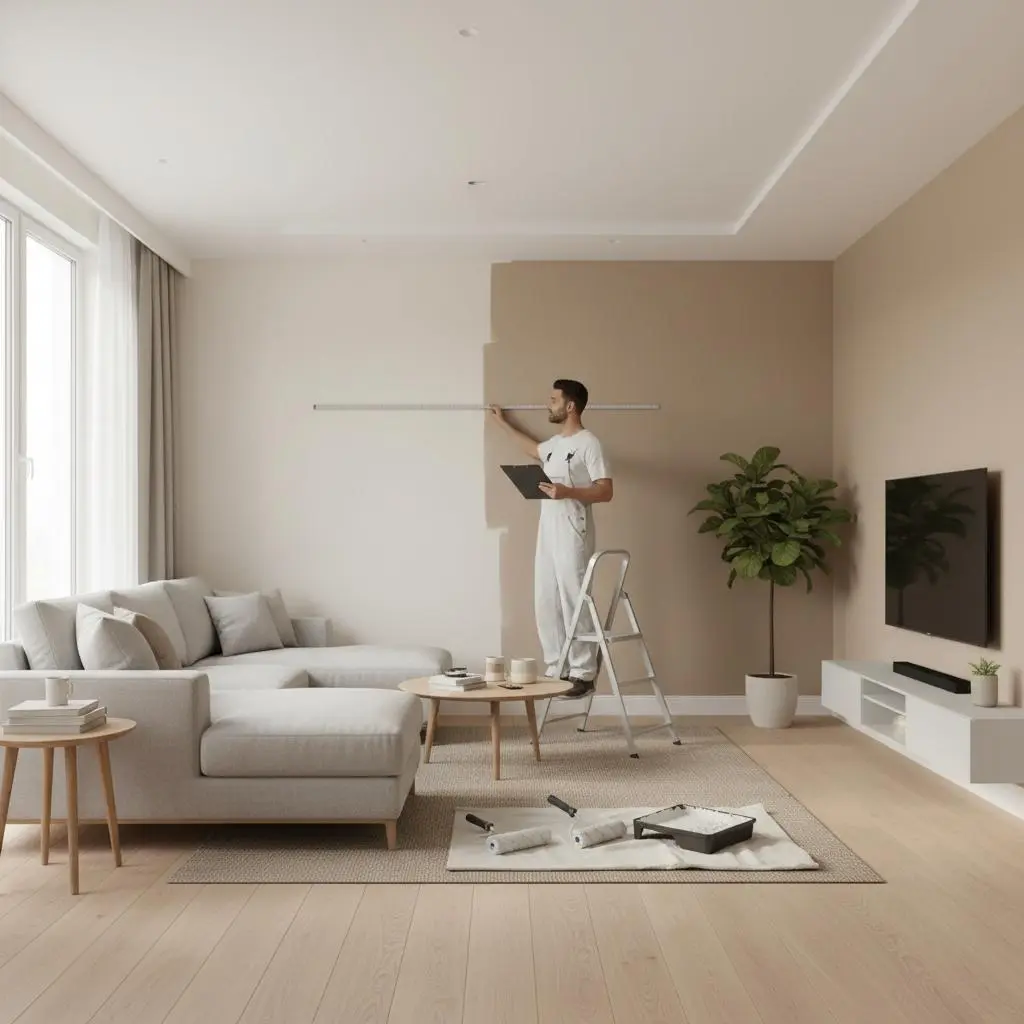
Buying the right quantity of paint is an important part of planning a home painting project.
Buying too little paint can interrupt the work and create problems when trying to match the original colour later. Buying too much can increase expenses and leave homeowners with unused material.
The solution is to estimate the paintable area and calculate the quantity required according to the selected paint's coverage and number of coats.
Whether you are painting a single bedroom, a 2 BHK apartment or an entire independent house, understanding paint quantity calculations can help you plan the project more effectively.
This guide explains how to measure walls, calculate paintable area, estimate litres of paint and understand the factors that influence actual consumption.
WHY IS PAINT QUANTITY ESTIMATION IMPORTANT?
Paint quantity estimation helps homeowners:
- Prepare a realistic material budget.
- Reduce unnecessary paint purchases.
- Avoid interruptions during painting.
- Compare contractor quotations.
- Plan the required number of paint containers.
- Understand material consumption.
- Reduce leftover paint and wastage.
However, calculations should be treated as estimates because actual paint consumption depends on surface condition, product formulation, application method and other factors.
- UNDERSTAND PAINT COVERAGE
Paint coverage describes the approximate surface area that a specified quantity of paint can cover under particular conditions.
It is commonly expressed in square feet per litre or square metres per litre.
For example, a paint product may specify an indicative coverage of 120 square feet per litre per coat.
This means that one litre may cover approximately 120 square feet for one coat under the stated testing or application conditions.
Actual coverage can vary depending on:
- Wall porosity.
- Surface smoothness.
- Existing paint condition.
- Application tools.
- Paint formulation.
- Colour change.
- Number of coats.
- Application technique.
Always refer to the selected product's technical information instead of using one coverage figure for every paint brand.
- HOW TO MEASURE WALL AREA
The first step is to measure the walls that require painting.
Use a measuring tape to record:
- Wall length.
- Wall height.
- Number of walls.
- Door dimensions.
- Window dimensions.
The basic formula is:
Wall area = Wall length × Wall height.
Example:
Suppose a bedroom measures:
Length: 12 feet.
Width: 10 feet.
Height: 10 feet.
Two longer walls:
12 × 10 = 120 square feet each.
Total = 240 square feet.
Two shorter walls:
10 × 10 = 100 square feet each.
Total = 200 square feet.
Gross wall area:
240 + 200 = 440 square feet.
Therefore, the gross wall area is 440 square feet.
- DEDUCT DOORS AND WINDOWS
Doors and windows generally do not require the same wall paint as the surrounding surface.
Their areas can be deducted when calculating the net paintable wall area.
For example:
Gross wall area = 440 square feet.
Door area = 21 square feet.
Window area = 15 square feet.
Net wall area:
440 - 21 - 15 = 404 square feet.
The net wall paintable area is approximately 404 square feet.
However, whether an opening should be deducted depends on the estimation method and the scope of work.
Small openings may sometimes be treated differently in contractor estimates.
- HOW TO CALCULATE CEILING AREA
If the ceiling is also being painted, calculate it separately.
Ceiling area = Room length × Room width.
For a room measuring 12 feet × 10 feet:
12 × 10 = 120 square feet.
The ceiling area is 120 square feet.
If the walls and ceiling both require painting:
Net wall area = 404 square feet.
Ceiling area = 120 square feet.
Combined paintable area = 524 square feet.
Calculate ceilings separately when different paint products or finishes are being used.
- HOW TO CALCULATE REQUIRED PAINT QUANTITY
The basic formula is:
Required paint quantity = Total paintable area × Number of coats ÷ Coverage per litre per coat.
Example:
Net wall area = 404 square feet.
Number of coats = 2.
Product coverage = 120 square feet per litre per coat.
Calculation:
404 × 2 ÷ 120 = 6.73 litres.
The estimated requirement is approximately 6.73 litres.
This is a theoretical calculation based on the assumed coverage.
The actual purchase quantity should account for the product's packaging sizes, application losses and the condition of the surface.
- COMPLETE HOUSE PAINT CALCULATION EXAMPLE
Consider a small residential painting project.
Suppose the total net wall area is 1,600 square feet.
The selected paint has an indicative coverage of 120 square feet per litre per coat.
The project requires two coats.
Calculation:
1,600 × 2 = 3,200 square feet of total coat coverage.
3,200 ÷ 120 = 26.67 litres.
Estimated wall paint requirement = 26.67 litres.
Now suppose the ceiling area is 500 square feet.
The selected ceiling paint has an indicative coverage of 110 square feet per litre per coat.
Two coats are planned.
500 × 2 ÷ 110 = 9.09 litres.
Estimated ceiling paint requirement = 9.09 litres.
Combined theoretical requirement:
26.67 + 9.09 = 35.76 litres.
This does not mean that exactly 35.76 litres should be purchased without checking product packaging, actual coverage and application requirements.
- HOW MANY LITRES OF PAINT ARE REQUIRED FOR A 2 BHK HOME?
The paint requirement for a 2 BHK home depends on the actual wall dimensions and painting scope.
Factors include:
- Number of rooms.
- Room dimensions.
- Wall height.
- Corridor area.
- Ceiling area.
- Number of coats.
- Paint coverage.
- Surface condition.
A 2 BHK apartment with compact rooms may require less paint than a larger apartment with high ceilings and extensive common areas.
Instead of using a fixed litre estimate for every 2 BHK property, calculate each room separately and combine the net paintable areas.
- CALCULATE PRIMER AND WALL PUTTY SEPARATELY
Paint, primer and putty are different materials.
They should not be calculated using the same coverage assumptions.
Primer
Primer quantity depends on the product coverage, surface porosity and application requirements.
Wall putty
Putty consumption depends on the required thickness, number of applications and surface condition.
Topcoat paint
Topcoat paint quantity depends on the net paintable area, number of coats and product coverage.
For an accurate material estimate, check the technical information for each product separately.
- FACTORS THAT CAN INCREASE PAINT CONSUMPTION
Even a correctly measured wall area may require more paint than expected.
Highly absorbent surfaces
Porous walls may absorb more material.
Rough surfaces
Textured or uneven walls may have greater effective surface area.
Dark-to-light colour changes
Some colour transitions may require additional coats or a suitable primer.
Old damaged surfaces
Repairs and surface variations may affect paint consumption.
Application technique
Roller, brush and spray applications may have different material requirements and losses.
Incorrect dilution
Using more water or thinner than recommended can affect coverage and final coating performance.
- COMMON MISTAKES WHEN ESTIMATING PAINT QUANTITY
Measuring only the floor area
Floor area is not the same as total wall area.
Ignoring ceiling surfaces
Ceilings require separate calculations if included.
Using one coverage rate for all brands
Different paint products have different coverage specifications.
Forgetting the number of coats
A two-coat project requires more paint than a one-coat calculation.
Ignoring wall condition
Damaged and porous walls may require additional preparation and material.
Mixing primer and paint calculations
Different materials have different coverage and application requirements.
- HOW TO REDUCE PAINT WASTAGE
Accurate measurement is the best starting point.
Other useful practices include:
- Purchase products according to the calculated requirement.
- Follow recommended dilution instructions.
- Prepare the wall correctly.
- Use appropriate application tools.
- Keep containers properly sealed.
- Store leftover paint according to manufacturer instructions.
- Maintain the product label and batch details.
- Avoid mixing incompatible paint systems.
For large projects, consider asking the painting contractor to prepare a material estimate before purchasing.
- PAINT QUANTITY ESTIMATION FOR HOMES IN PATNA
Homeowners planning painting work in Patna can benefit from understanding their paintable area before requesting quotations.
Whether the property is a small apartment or an independent house, accurate measurement helps clarify the quantity of paint, primer and other materials required.
PaintGen offers painting services and a price calculator to help homeowners begin planning their projects.
Before finalising a material estimate, consider the wall condition, selected paint category, coverage specifications and required number of coats.
Visit https://www.paintgen.in/ to explore painting services and discuss your home painting requirements.
FINAL THOUGHTS
Estimating paint quantity begins with measuring the actual surface area.
Calculate the walls, deduct relevant openings, include ceilings where required and apply the selected product's coverage rate to determine the theoretical quantity.
Remember that real-world paint consumption varies according to surface conditions, application methods and manufacturer specifications.
A proper estimate can help homeowners manage materials, compare quotations and reduce unnecessary wastage.
Planning to paint your home in Patna? Explore PaintGen's services and start preparing your painting project.
Questions people ask
How do I calculate how much paint I need for my house?
Measure the net wall area, multiply it by the required number of coats and divide the result by the selected paint's coverage per litre per coat. Calculate ceilings separately when necessary.
How much area does one litre of paint cover?
Coverage varies by product, surface condition and application method. Check the manufacturer's technical information for the exact product rather than relying on a universal coverage figure.
Should I include primer when calculating paint quantity?
Primer should be calculated separately because it is a different material with its own coverage and application requirements. The same applies to wall putty.
Does wall condition affect paint quantity?
Yes. Porous, rough or uneven walls may consume more paint than smooth, properly prepared surfaces. Product coverage can also vary with application technique and the number of coats.
Last updated 9 November 2026.